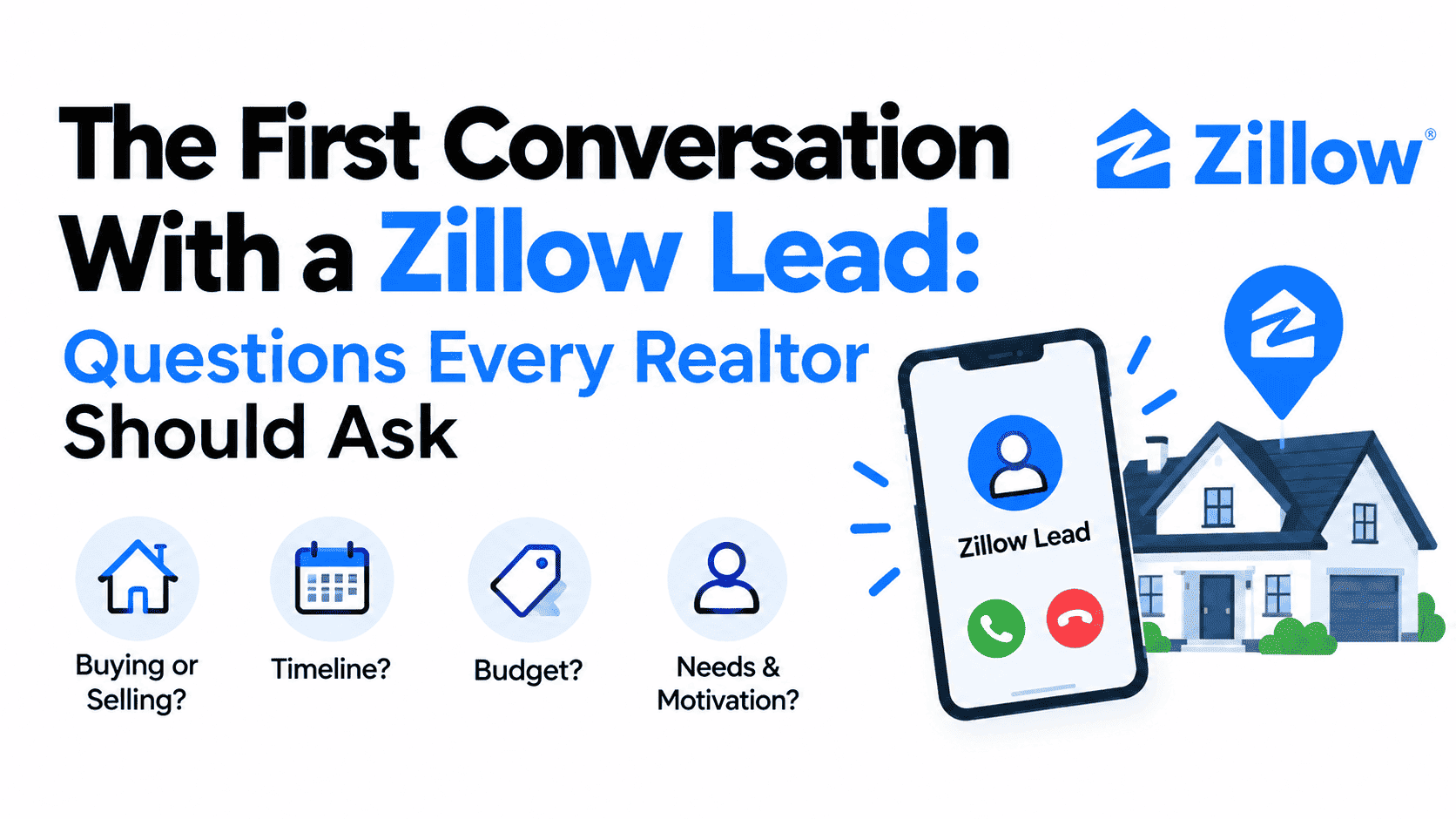
The First Conversation With a Zillow Lead: Questions Every Realtor Should Ask
The first call with a Zillow lead goes best when you treat it as a conversation about the person rather than a screening. Confirm why they reached out, learn their situation with a few open questions, answer theirs honestly, and agree on a next step.
Why the first conversation matters
Most buyers don't audition many agents. In Zillow's consumer surveys, close to half of buyers who used an agent hired the first one they contacted, and the majority spoke with only one or two before deciding. Sellers lean even more heavily toward the first agent they call. Whatever your close rate is on a given lead source, a large share of it is decided in the first conversation.
Speed matters too, but be careful with the statistics you see quoted. Research on online inquiries across industries shows that contacting a lead within an hour makes a meaningful conversation far likelier than waiting longer. Vendors selling response tools often quote sharper numbers, like a 5-minute window and a 21x lift. Treat those as directional. The practical lesson is simple: respond quickly, and make the response worth receiving.
What buyers say they want from an agent is consistent: someone trustworthy, responsive to their needs, and knowledgeable about the local market. A first call is the cheapest place to demonstrate all three.
Before you dial: a three-minute prep
The best first calls sound unrehearsed because the prep was done beforehand. Before you pick up the phone, check the following.
The home they inquired about. Know the price, days on market, neighborhood, and anything unusual about the listing. You should be able to answer the first obvious question without putting them on hold.
What they actually did. A tour request, a saved home, a direct call, and a Zestimate question are different signals and deserve different openings.
Whether you've talked before. If they're a nurture lead or a repeat inquiry, open by acknowledging that history.
Your goal for the call. For most leads the goal is not to close. It is to understand their situation and agree on a next step, whether that's a tour, a set of listings by text, or a follow-up date.
Your tone. People who submit an inquiry online did not ask to be cold-called by a stranger reading a script. Plan to sound like a helpful local.
Know what kind of lead you're calling
"Zillow lead" covers several situations, and the right opening depends on which one you have.
Tour request. They asked to see a specific home, so their intent is the clearest. Confirm the home and move toward scheduling.
Live phone connection. They chose to talk now. Be brief, useful, and ready to answer questions.
Saved or inquired-about home. Intent ranges from serious to casually browsing. Start by asking what drew them to the home.
Zestimate or home-value question. This may be an owner curious about value rather than a buyer. Ask what prompted the question before assuming anything.
Nurture lead. They weren't ready last time. Reference the earlier contact and ask what has changed.
Intent also shifts within a single lead. Someone who clicked "request a tour" on a Friday night may be ready, or may have been daydreaming. Your first questions should let them tell you which.
The first 30 seconds
A strong opening does four things: it says who you are, explains why you're calling, asks permission, and asks an easy first question.
"Hi Maria, this is Sam with [brokerage]. I got your inquiry about the house on Maple Street. Is now an okay time to talk for a couple of minutes?"
If they say yes, move straight to something easy and open:
"Great. What was it about that house that caught your eye?"
A few details make the difference:
Say plainly that you're an independent licensed agent who received their inquiry through the site. That avoids any confusion about who is calling and why.
Ask for their time. A quick "Is now a good time?" costs nothing and avoids a rushed, distracted conversation. If it isn't, offer two times and a preferred channel.
Ask how they like to communicate. In Zillow's consumer survey, a little over half of buyers who worked with an agent preferred text or a messaging app, about a third preferred phone, and the rest preferred email. If they don't pick up, a short text is often the better second attempt.
Leave them room. Ask one question, then stop talking. The silence after a good question is where the useful answers come from.
The questions, grouped by purpose
A simple way to structure the call is around three goals: get an appointment, learn which homes and areas interest them, and understand what's driving the move. You won't need every question on every call. Pick the ones that fit the person and the moment.
Motivation:
What is it about this home that caught your eye? (Listen for features, lifestyle needs, and what they'd be willing to trade off.)
Did you just start looking, or have you been at it a while? (Reveals the stage of their search, past offers, and any search fatigue.)
What's prompting the move? (Common answers include a job change, a growing family, a lease ending, or an investment.)
Timeline:
When would you like to see it, and when are you hoping to move? (Shows whether there's a lease end, a home sale to coordinate, or real urgency.)
Location:
Are there other homes or areas you've been looking at? (Tells you how broad the search is, the likely price range, and which listings are worth sending.)
Needs:
What must your next home have, and what would rule one out? (Separates must-haves from nice-to-haves.)
Agent status:
Are you already working with an agent, or have you signed anything? (Reveals existing agreements and why they contacted you.)
Finances:
Have you talked with a lender or looked at what you can afford? (Asks about pre-approval status without requesting specific numbers.)
Experience:
Have you bought a home before? (Tells you how much explanation and guidance they may want.)
Working style:
How would you like me to keep you updated, and how often? (Confirms their preferred channel and pace.)
Next step:
Would you like to see it on [day]? (Shows whether they're willing to meet or need something first.)
Motivation: start with the "why"
Motivation questions build rapport and give you the context every later answer depends on. Follow up with curiosity, not a checklist. If they say they want a bigger yard, ask who it's for. If they mention a job change, ask when it starts. Each answer tells you what to show them next.
Timeline: find out what's real
People often say "just looking" when they mean "not ready to commit to anything yet." A softer timeline question helps: "If the right home came along, how soon would you want to move?" That gives you an honest picture without forcing a decision.
Location and needs: widen the lens
Asking about other homes does two jobs. It shows you what they actually want, and it gives you a reason to follow up with listings. Pair it with a needs question like "What would make a home a definite no?" Buyers usually know their dealbreakers faster than their wish-list.
Agent status: ask it respectfully
This is the question agents most often skip or ask clumsily. Ask it as a matter of clarity, not interrogation: "Just so I don't step on anyone's toes, are you working with an agent right now?" A "yes" doesn't always end the conversation. Sometimes the person is unhappy with their agent, or their agreement is nearly up. But if an agreement is in force, respect it.
Finances: keep it light
You don't need income or balances on a first call. Ask whether they've started the lender conversation, and offer to point them toward a few lenders to compare. Many buyers contact only one lender, and gentle encouragement to compare can help them without pressure.
The appointment: ask early, ask clearly
Booking time together is usually the strongest predictor of a relationship, so ask for it early in the call rather than at the end. Be specific and make it easy: "I can show it Saturday morning or Sunday afternoon. Which works better?" If the person is clearly browsing, offer a lower-pressure next step, like sending matching listings, and agree on when you'll check in.
Answer their questions too
The call is a two-way conversation, and how you answer their questions often matters more than how you ask yours. Expect these:
"Is it still available?" Check before you call. If you don't know, say so and find out.
"What does it cost to work with you?" Be direct. Explain how you're paid, what the buyer's responsibilities are, and how that may differ from what they've read online. Industry rules on buyer agent compensation have changed, so don't assume they already understand.
"Do I have to sign something?" Explain the difference between a tour agreement and a longer buyer representation agreement, what each commits them to, and that requirements vary by state. Encourage them to read anything before they sign it.
"What are the other costs?" Surveys show most buyers run into at least one expense they didn't anticipate, such as loan fees and appraisal costs. Mentioning that early builds trust.
"What's the neighbourhood like?" Answer from real knowledge. If you don't know something, say you'll find out.
"Why should I work with you?" Have a short, honest answer ready about your experience, your local focus, and how you communicate.
Handling common objections
When a lead pushes back, the response is usually the same: acknowledge, don't argue, and leave the door open.
"I'm just looking." Respond with: "That's a great place to start. What kind of home are you looking at? I can send you a few that match so you don't have to dig."
"I'd rather text." Respond with: "Of course. I'll text you in a minute. What's the best way to reach you after that?"
"I already have an agent." Respond with: "Thanks for telling me. I don't want to interfere with anything. Is there anything I can help with on this particular home?"
"I'm not ready to meet anyone." Respond with: "No pressure at all. Would it help if I sent a few listings and you let me know what you think?"
"What's your commission?" Answer directly and plainly, explain how it works in your market, and invite follow-up questions.
Ending the call and following up
Before you hang up, confirm three things: what you'll do next, what they'll do next, and when you'll be in touch. Then send a short text within a few minutes while the call is fresh.
"Thanks for chatting, Maria. I'll send you three homes near Maple Street tonight. Let me know which ones you'd like to see, and I'll set up a time that works for you."
The follow-up is where many leads are won or lost. People who say "not yet" on the first call often become clients months later, but only if someone stays in touch in a useful, low-pressure way.
Common mistakes
Reading a script word for word. Scripts are useful for practice, not for the call itself.
Turning questions into an interrogation. Stacked questions feel like a form, not a conversation.
Ignoring the channel. Calling repeatedly when the person has signaled they would rather text.
Dismissing leads who already have an agent, or, worse, working around an existing agreement.
Promising what you can't control, such as prices, timing, or competing offers.
Skipping the next step. A pleasant call with no follow-up plan is usually forgotten by the next day.
A word on expectations: published conversion figures for online leads vary widely, and the numbers floating around mostly come from vendors and individual agents rather than neutral studies. Results depend on your market, price point, lead type, and follow-up. A first conversation that ends with "not yet" isn't a failure. It is the start of a relationship.
Practicing the first call with ALM Trainer
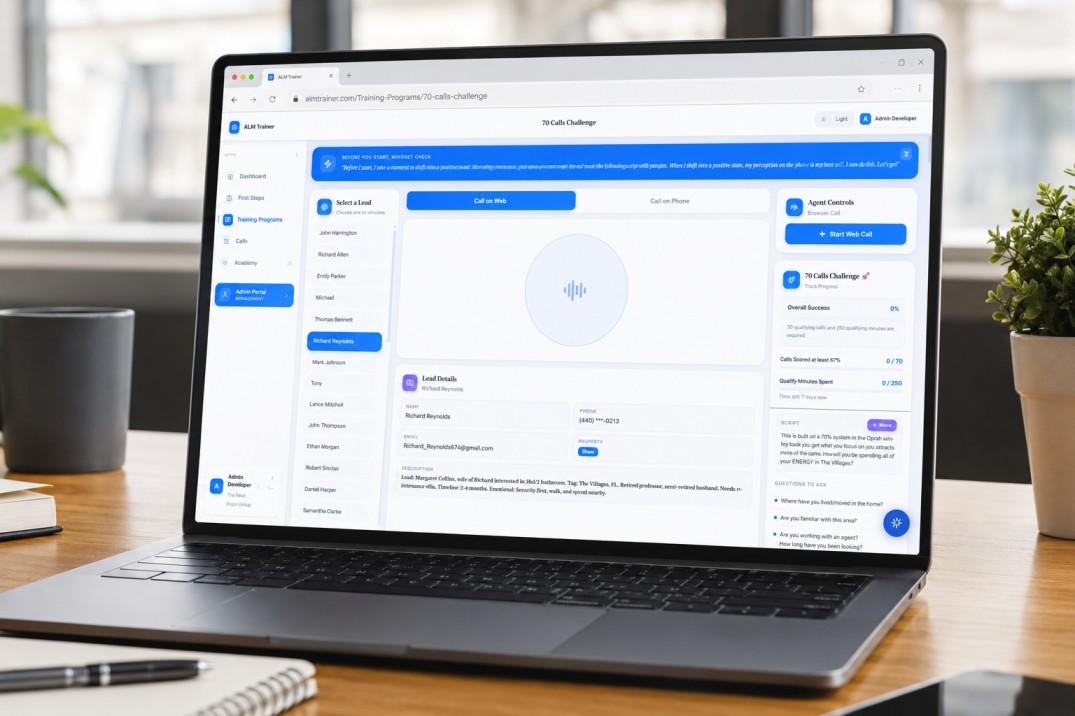
Knowing the right questions is one thing. Asking them smoothly, in the right order, under real conversational pressure is another, and that only comes from repetition. That's the gap almtrainer.com is built to close.
ALM Trainer lets agents practice first conversations against 100+ AI leads, each with a different personality, motivation, and set of objections. After every call, it gives you recommended questions, so you can see what you could have asked, what you missed, and how to steer the conversation better next time. Instead of learning on live leads you paid for, you build confidence and habits in practice.
For real estate teams that hire new realtors every month, this is a no-brainer. New agents get a safe place to run dozens of conversations before they ever touch a real lead, managers don't have to role-play with every new hire, and the whole team ramps up faster. Better first calls from day one mean fewer wasted leads and a more consistent experience for every buyer who inquires.
Key takeaways
Prepare for three minutes, then call with a clear goal: understand them and agree on a next step.
Open with who you are, ask permission, and start with an easy question about the home.
Ask open questions about motivation, timeline, needs, and agent status, one at a time, and listen.
Answer their questions plainly, especially about costs and what they'd be signing.
Ask for the appointment early, and offer a low-pressure alternative when they're not ready.
End with a clear next step, and follow up by text while the call is fresh.
Practice before you go live, because the first call is hard to redo.